
How to Create a Customer-Focused Business Strategy?
Creating a customer-focused strategy for your business involves concentrating on understanding and meeting the needs and expectations of your customers. By placing the customer at the center of your business operations, you can improve customer satisfaction, customer loyalty, and ultimately drive business growth. The BROSH CRM system provides the tools and infrastructure necessary to create and implement a customer-focused business strategy in a practical and effective manner.
What is a Customer-Focused Business Strategy?
A Customer-Centric Business Strategy is a business approach that places the customer at the center of all business decisions. This means that every department in the organization – from product development to customer service – operates with the understanding that the primary goal is to deliver value to the customer and improve the customer experience.
Why Is It So Important?
The practical significance in numbers:
- Customer-focused companies earn 60% more profit compared to competitors
- 84% of companies that invest in improving customer experience report increased revenue
- 89% of customers switch to a competitor after a poor experience
- Loyal customers are worth 10 times their first purchase
- 70% of the buying experience is based on how the customer feels they are treated
Here are several steps to help you develop a customer-focused business strategy:
Step 1: Define Your Target Customers
Clearly identify and understand your target customers, including their demographics, preferences, and pain points. This will help you tailor your strategy to meet their specific needs.
What Should You Do?
- Customer Segmentation: Divide your customer base into groups based on common characteristics:
- Demographics: age, gender, location, income
- Behavior: purchase frequency, transaction value, preferred communication channels
- Psychographics: values, hobbies, lifestyle
- Business needs: company size, industry, challenges
- Analyze Existing Data: Use information from:
- CRM system (like BROSH)
- Sales data and purchase behavior
- Website and app analytics
- Customer feedback and surveys
- Market Research: Understand industry trends and competition
- Identify Pain Points: What bothers customers? What problems are they trying to solve?
How BROSH Helps: The BROSH system enables creation of custom fields for each customer type, automatic segmentation, and filtered views by different criteria – allowing you to manage each customer group in the best way for them.
Step 2: Collect Customer Feedback
Gather feedback from your customers through surveys, interviews, social media, and other channels. Understand their experiences, challenges, and suggestions to gain insights on how you can serve them better.
Methods for Collecting Feedback
- Automated Surveys:
- NPS (Net Promoter Score) – Would you recommend us?
- CSAT (Customer Satisfaction) – How satisfied are you?
- CES (Customer Effort Score) – How easy was it to get service?
- Personal Interviews: In-depth conversations with key customers
- Social Media Monitoring: What are people saying about you on networks?
- Analyze Inquiries and Complaints: Lessons from issues that arose
- Reviews and Ratings: What are people writing about you online?
- Focus Groups: Focus group discussions
- Real-time Feedback: Chat, email, phone
How BROSH Helps: Automatic integration of satisfaction surveys after transactions or inquiries, collecting and analyzing feedback in one place, and creating alerts for negative feedback for immediate handling.
Step 3: Build Customer Personas
Develop customer personas based on the data you’ve collected. Personas are fictional representations of your typical customers and help you understand their motivations, behaviors, and goals. This will enable you to create targeted strategies and personalize customer interactions.
What Should a Persona Include?
Each persona should include:
- Name and Photo: Make the persona tangible
- Demographic Background: age, occupation, income, location
- Role and Company: (for B2B) role, company size, industry
- Goals and Objectives: What are they trying to achieve?
- Challenges and Pain Points: What bothers them? What prevents them from succeeding?
- Behavior and Information: Where do they search for information? How do they make decisions?
- Tools and Technologies: What tools do they use?
- Preferred Communication Channels: Email, phone, WhatsApp, meeting?
Example Persona
“Dana – Sales Manager at Medium-Sized Company”
- Age: 38, married, 2 children
- Role: Manages sales team of 8 people
- Goals: Increase sales by 20%, improve customer retention
- Challenges: Difficulty tracking leads, lack of visibility into team performance
- Current Tools: Excel, emails, no CRM
- Needs: Easy-to-use system, automated reports, mobile access
How BROSH Helps: You can create custom fields tailored to each persona, define different processes for each customer type, and send targeted communication to each group.
Step 4: Map the Customer Journey
Visually represent the customer journey by mapping all touchpoints and interactions customers have with your business. Identify pain points, areas for improvement, and opportunities to enhance the customer experience at each stage.
Stages in the Customer Journey
- Awareness:
- The customer discovers they have a problem or need
- Touchpoints: ads, social networks, recommendations, online content
- What to do: Create quality content, SEO, sponsored campaigns
- Consideration:
- The customer examines alternative solutions
- Touchpoints: website, demos, case studies, comparisons
- What to do: Provide detailed information, demonstrations, consultation
- Purchase:
- The customer decides to buy
- Touchpoints: quote, negotiation, contract signing
- What to do: Simple and fast process, transparent pricing, clear terms
- Onboarding:
- Starting to use the product/service
- Touchpoints: training, setup, initial support
- What to do: Structured onboarding journey, guides, personal support
- Usage:
- Ongoing use of product/service
- Touchpoints: technical support, updates, tips
- What to do: Fast support, regular updates, satisfaction checks
- Retention:
- Keeping the customer over time
- Touchpoints: renewals, upgrades, promotions
- What to do: Reminders, customized offers, loyalty programs
- Advocacy:
- The customer becomes a brand ambassador
- Touchpoints: recommendations, reviews, social media
- What to do: Encourage referrals, referral program, success stories
How BROSH Helps: BROSH enables building automated customer journeys with reminders, tasks, and emails at each stage. This ensures no customer “falls through the cracks.”
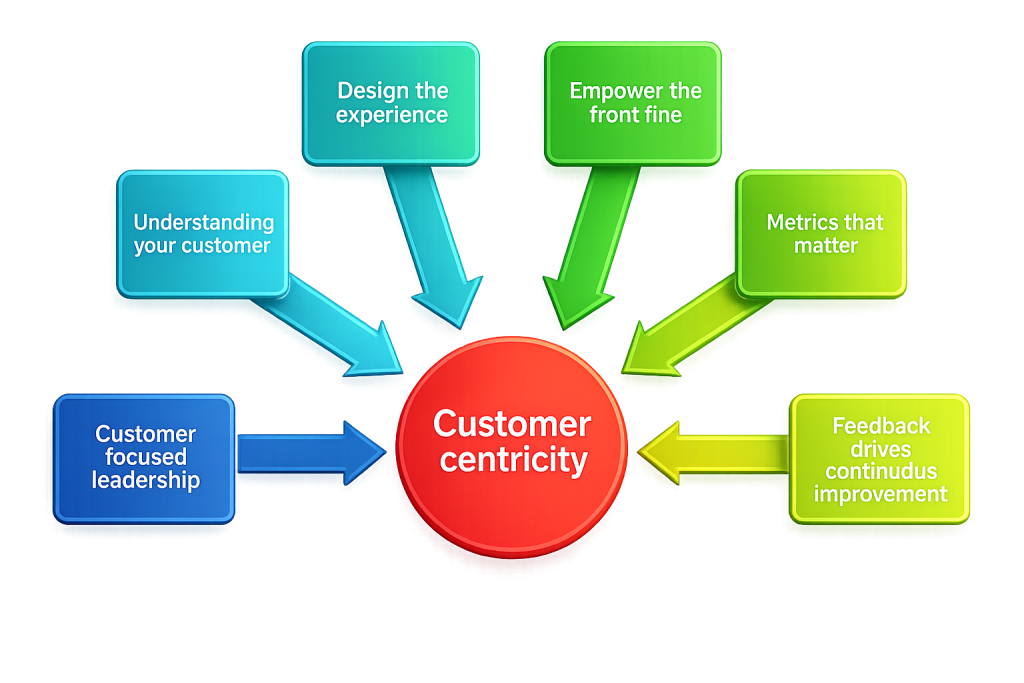
Step 5: Set Customer-Focused Goals
Define specific goals that align with your customer-focused strategy. These goals can include improving customer satisfaction scores, increasing customer retention rates, or reducing customer complaints.
Examples of Measurable Goals
- Improve NPS to 50+ within 6 months
- Increase customer retention rate to 90% of returning customers
- Reduce response time to inquiries from 24 hours to 4 hours
- Increase CLV (Customer Lifetime Value) by 30%
- Improve percentage of referring customers to 40% of all customers
- Reduce Churn Rate from 15% to 8% annually
- Improve CSAT from 75% to 90%
Important: Goals should be SMART:
- Specific
- Measurable
- Achievable
- Relevant
- Time-bound
How BROSH Helps: Customizable dashboards displaying KPIs in real-time, alerts when metrics decline, and automated reports that help track progress toward goals.
Step 6: Empower Employees for Excellence in Service
Ensure your employees understand the importance of delivering exceptional customer experiences. Provide them with the training and resources needed to effectively engage with customers and resolve their issues.
How to Empower Employees?
- Comprehensive Training:
- Communication and empathy skills
- In-depth knowledge of products and services
- Using systems and tools (CRM, support)
- Techniques for handling difficult customers
- Decision-Making Authority: Allow employees to solve problems immediately without unnecessary escalation
- Accessible Information: Everything must be in one place – history, preferences, previous inquiries
- Feedback and Improvement: Share customer insights with the team and celebrate successes
- Incentives: Reward excellent service and “above and beyond” dynamics
How BROSH Helps: 360-degree view of every customer, including all history and communication. Employees see exactly what happened with the customer before and can provide personalized and fast service.
Step 7: Cultivate a Customer-Focused Culture
Foster a culture in your organization that prioritizes customer satisfaction. Encourage employees to go above and beyond to meet customer needs, reward exceptional customer service, and promote customer-centric thinking at all levels.
How to Build a Customer-Focused Organizational Culture?
- Leadership by Example: Managers and executives must be personal examples
- Clear Vision: Embed the customer-focused vision in all messaging and internal communication
- Integrate into KPIs: Make customer satisfaction part of everyone’s performance metrics
- Share Success Stories: Celebrate excellent service and share it with everyone
- Share Data: Present metrics and insights to all employees
- Cross-departmental Collaboration: Break down silos – sales, service, and marketing must work together
- Reward and Recognition: Acknowledge and reward employees who demonstrate excellence in customer service
Step 8: Personalize Customer Interactions
Leverage customer data and technology to personalize interactions and deliver customized experiences. Use Customer Relationship Management (CRM) systems to track customer preferences, purchase history, and communication preferences. This enables you to deliver relevant recommendations, promotions, and targeted marketing campaigns.
Levels of Personalization
- Basic Level: Addressing by first name, referencing history
- Intermediate Level: Recommendations based on past purchases, offers based on preferences
- Advanced Level: Predicting needs, real-time personalized messages, behavior analysis
Examples of Personalization
- Personalized Emails: Different content for each segment
- Product/Service Recommendations: Based on previous purchases
- Dynamic Pricing: Tailored discounts for loyal customers
- Website Content: Different landing pages for each persona
- Customer Service: Priority for VIP customers
How BROSH Helps: BROSH enables saving every detail about the customer, creating tags and automatic segmentation, and sending targeted communication to each group. Every customer journey is personalized based on behavior and profile.
Step 9: Continuous Improvement
Regularly analyze customer feedback, monitor customer satisfaction metrics, and track the effectiveness of your customer-focused initiatives. Use this information to identify areas for improvement and make necessary adjustments to your strategy.
Continuous Improvement Cycle
- Measure: Collect data and metrics
- Analyze: Identify trends, problems, and opportunities
- Plan: Define improvements and actions
- Do: Implement changes
- Check: Measure results
- Adjust: Update strategy accordingly
Important Metrics to Track Regularly
- NPS (Net Promoter Score)
- CSAT (Customer Satisfaction Score)
- CES (Customer Effort Score)
- Churn Rate
- CLV (Customer Lifetime Value)
- Retention Rate
- First Response Time
- Resolution Time
How BROSH Helps: Automated dashboards with all metrics, scheduled reports sent to managers, and historical analyses that enable identifying trends over time.
Step 10: Customer-Driven Innovation / Insights
Stay current with market trends and evolving customer needs. Continuously innovate your products, services, and processes based on customer insights to stay ahead of competitors and meet changing customer expectations.
How to Innovate Based on Customer Insights?
- Track Trends: Understand what’s happening in the industry and with competitors
- Beta Testing with Customers: Involve loyal customers in new developments
- Co-Creation: Build products/services together with customers
- Analyze Feedback: Look for patterns in requests and complaints
- Continuous Innovation: Regular updates and improvements
- Document Ideas: Create a system for collecting ideas from various sources
How BROSH CRM Helps Implement the Strategy
The BROSH CRM system is the perfect tool for implementing a customer-focused business strategy:
Key Features Supporting the Strategy
- Full 360-degree Customer View: All information, history, and interactions in one place
- Advanced Segmentation: Divide customers into groups by any criteria
- Customer Journey Automations: Build automated processes tailored to each stage of the journey
- Custom Dashboards and Reports: Track all important metrics in real-time
- Inquiry and Ticket Management: Full tracking until resolution
- No-Code Customization: Adapt the system to your unique processes
- Integrations: Connect to all the tools you use
- Hebrew Interface: Tailored for the Israeli market
- Access from Anywhere: Cloud, mobile, Web interface
Examples of Using BROSH
- Automated Onboarding: Series of emails and training for new customers
- Smart Reminders: For meetings, subscription renewals, follow-ups
- Automated Satisfaction Surveys: After every interaction
- Inquiry Prioritization: By urgency, customer value, SLA
- Up-sell and Cross-sell: Automated recommendations based on history
Summary and Key Takeaways
Remember, creating a customer-focused strategy is an ongoing process. It requires deep understanding of your customers, commitment from your entire organization, and willingness to adapt and evolve as customer needs change.
Key Principles:
- ✅ Customer at the Center – Every business decision should start with the question “What does the customer need?”
- ✅ Continuous Measurement – You can’t improve what you don’t measure
- ✅ Personalization – Customers expect a personalized experience
- ✅ Organizational Culture – The entire team must be committed to customer satisfaction
- ✅ Right Technology – Advanced CRM like BROSH is the key to success
- ✅ Continuous Improvement – The world changes, and the strategy must be updated
Next Steps:
- 📊 Start with mapping the current customer journey
- 🎯 Define customer personas and measurable goals
- 💡 Implement an advanced CRM system like BROSH
- 📈 Measure success metrics and track them
- 🚀 Create automations for customer journeys
- 👥 Train the team on the importance of customer focus
Ready to create a customer-focused business strategy? Start with BROSH CRM today!

רות ברנע
שיווק במייל הוא אמנות שדורשת מיומנות וסבלנות! המאמר מספק טיפים מצוינים ליצירת קמפיינים מוצלחים – מבניית רשימות איכותיות, דרך עיצוב תבניות מושכות, ועד למדידת הצלחה ואופטימיזציה. במיוחד התרשמתי מההמלצות על איך לכתוב תוכן שגורם לקוראים לפתוח וללחוץ. מדריך מעולה!